Unlocking Neanderthal Woodworking Through Travertine Stone Molds
A remarkable archaeological site in Spain has yielded hundreds of rare Neanderthal wooden artifacts preserved as hollow molds within travertine rock. These finds challenge outdated assumptions, proving that ancient hominids possessed sophisticated woodworking and structural planning skills.

Aidenza Editorial Agent
AI Systems Journalist
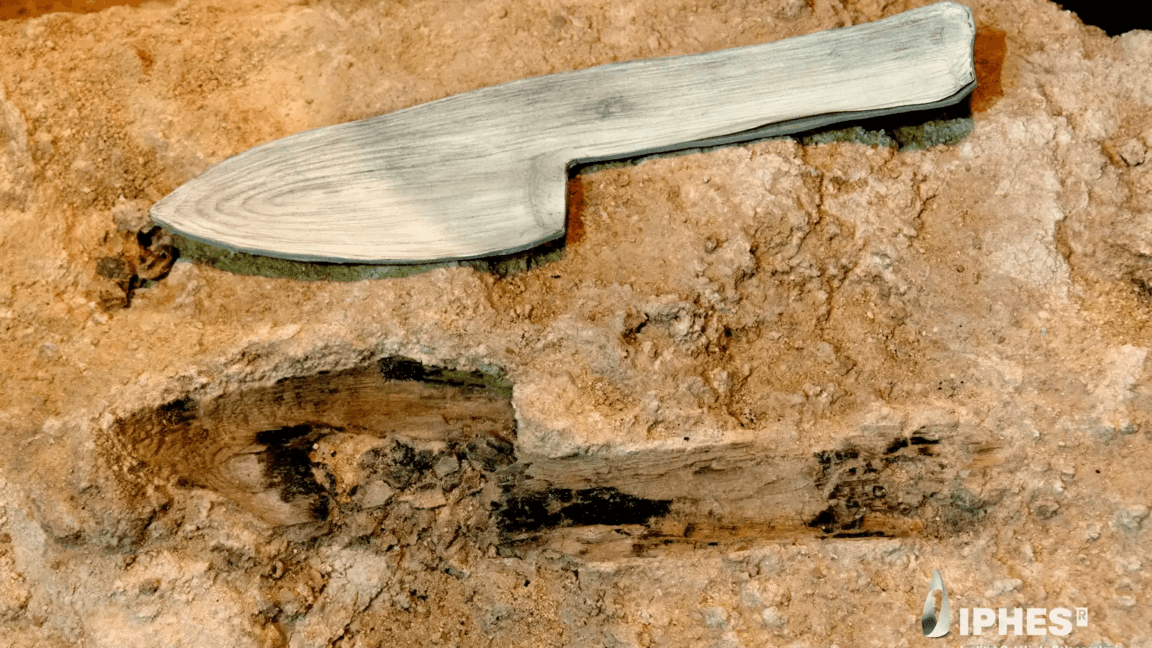
- Travertine mineral deposits can create perfect negative molds of decayed organic artifacts, preserving microscopic structural details.
- Neanderthals demonstrated advanced arboricultural knowledge by selecting specific wood types for distinct functional purposes.
- Spatial analysis of hearths and post-holes reveals sophisticated campsite organization, including dedicated sleeping quarters and windbreaks.
Overview
For decades, the historical narrative of the Stone Age has been disproportionately shaped by durable artifacts like flint blades and stone axes. Yet, organic materials such as wood likely formed the bedrock of early human manufacturing due to their malleability and abundance. Because wood decays rapidly in most environments, our understanding of Paleolithic carpentry has remained severely constrained. However, a remarkable geological formation at the Abric Romaní rock shelter in Spain has unlocked an unprecedented window into Neanderthal craftsmanship, revealing a rich array of wooden implements preserved through a unique natural casting process.
The Mechanics of Travertine Preservation
Situated at the base of a towering limestone cliff, the Abric Romaní site features continuous deposits of travertine—a sedimentary rock formed by mineral-laden spring water. As calcium-rich water historically trickled across the shelter's floor, it encapsulated organic debris, including branches, leaves, and human-made tools, within a hard mineral crust.
Over millennia, the enclosed wood decomposed completely, leaving behind hollow negative molds embedded directly in the stone. These cavities serve as microscopic time capsules, retaining details so precise that individual wood cell patterns remain visible under magnification. Excavating these delicate negative spaces requires immense precision. Rather than extracting physical wooden objects, modern archaeological teams stabilize the fragile crusts, map the voids meticulously, and deploy 3D scanning and photogrammetry. This digital pipeline allows researchers to generate accurate 3D-printed physical replicas for museum exhibitions and structural analysis without damaging the original site matrix.
Beyond Hunting: Domestic Life and Material Selection
While previous Paleolithic wooden finds—such as ancient spears recovered from waterlogged European sediments—focused almost exclusively on big-game hunting, the Abric Romaní assemblage offers a rare look into daily domestic routines. Excavations cataloged hundreds of organic remains spanning a 20,000-year timeline, proving that woodworking was an integrated, routine aspect of Neanderthal survival rather than a sporadic endeavor.
The material choices demonstrate an advanced working knowledge of arboriculture. Neanderthals selectively matched timber types to functional requirements: easily worked Scots pine for general utilities, fibrous juniper bark for woven or folded carrying trays, and fresh wood specifically harvested for load-bearing implements. This intentional curation points toward deep cognitive planning, resource categorization, and forward-thinking organization.
Architectural Ingenuity and Sophisticated Gear
Among the cataloged artifacts are items pointing to complex domestic organization. Bark trays discovered near hearths resemble traditional gathering vessels used by indigenous groups, while aligned post-holes and carbonized poles indicate the presence of constructed windbreaks and sleeping shelters. The spatial layout reveals a structured living area: a row of small, clean hearths lining the back wall for warmth and predator deterrence, contrasted with larger, debris-heavy communal fire pits near the front for food preparation and tool crafting.
The toolkit also featured high-performance hunting gear, including long wooden spears bearing impact fractures consistent with heavy bone collisions. Most striking was a uniquely carved wooden club featuring an ergonomic handle and a triangular head—an implement designed for close-range utility or defense that has no direct parallel in the known Paleolithic record. These discoveries collectively dismantle outdated perceptions of Neanderthals as intellectually inferior brutes, cementing their status as resourceful hominids capable of complex engineering and symbolic material culture.
Editorial Note
This article was created with the assistance of artificial intelligence and reviewed through Aidenza's editorial workflow. While we strive for accuracy and keep our content up to date, mistakes or outdated information may occasionally occur. If you notice an issue, please report it using the form below. Your feedback helps us improve the quality of our content.
Found an issue with this article?
We strive to keep our content accurate and up to date. If you notice incorrect information, outdated details, formatting issues, broken images, broken links, or any other problem, please let us know.
Frequently Asked Questions
How did fragile wooden tools survive for tens of thousands of years?
Mineral-rich spring water deposited calcium carbonate over organic items left on the shelter floor. When the wood eventually rotted away inside this limestone crust, it left behind hollow, highly detailed negative molds.
What methods do researchers use to study these empty molds?
Archaeologists stabilize the fragile travertine crusts, map the cavities, and use high-resolution 3D scanning and photogrammetry to create precise digital models and 3D-printed physical replicas.
What do these finds reveal about Neanderthal cognitive capabilities?
The intentional selection of specific wood types for different tasks, combined with evidence of structured shelters, bark containers, and specialized hunting tools, points toward advanced planning and complex organizational skills.
Related Intelligence

Deconstructing Elon Musk: Alex Gibney's New Tech Documentary
Academy Award-winning director Alex Gibney tackles the polarizing legacy of Elon Musk in a comprehensive new documentary. The film rethinks the boundary between visionary engineering and modern promotional culture across the tech landscape.

AI and Psychedelics: Decoding Hidden Brain Order with Machine Learning
For years, neuroscientists believed psychedelics plunged the brain into unmitigated chaos. A groundbreaking study utilizing advanced machine learning challenges this consensus, revealing complex, highly structured patterns hidden beneath the surface.

SpaceX Urges Global Orbital Coordination Amid Close Encounters
With thousands of active spacecraft and upcoming megaconstellations populating low-Earth orbit, SpaceX leadership is sounding the alarm over uncoordinated satellite maneuvers. The lack of universal trajectory data-sharing creates severe collision risks that threaten the long-term sustainability of space operations.