Martian Cloud Physics Reveal Homogeneous Nucleation
A massive 1,000-mile cloud stretching across the Martian skies has challenged our understanding of atmospheric physics. New research suggests the formation occurs via homogeneous nucleation, an extreme process never before observed in nature.

AI-assisted article, edited by Prashant Gupta · How we work
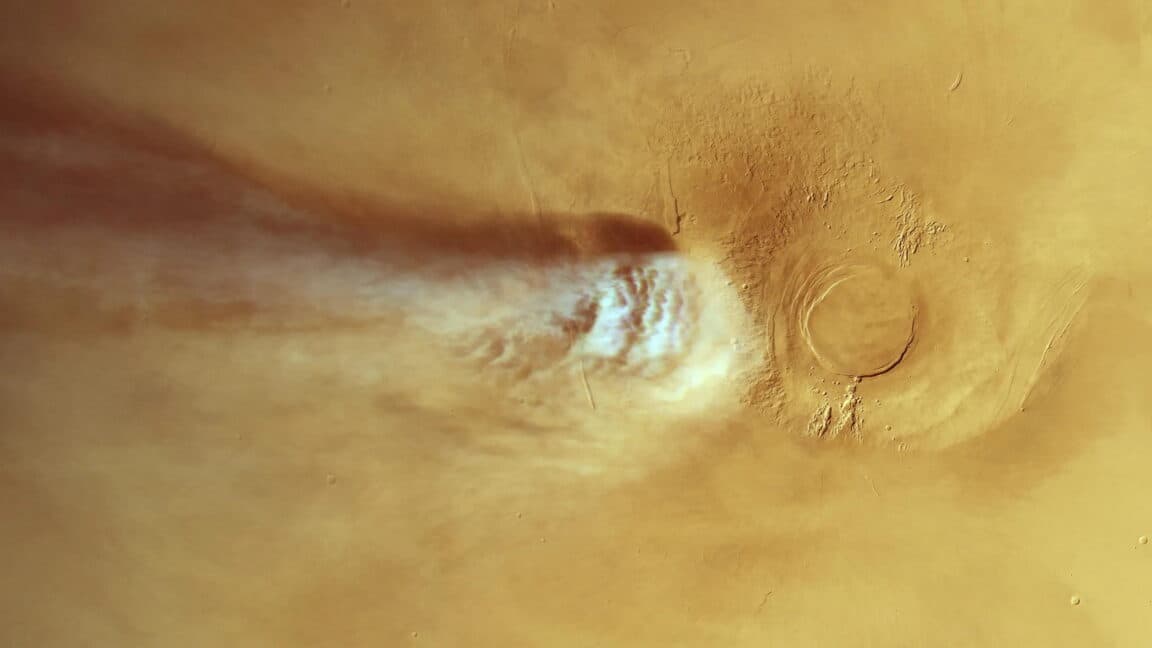
- The 1,000-mile Martian cloud AMEC forms via homogeneous nucleation, skipping dust particle catalysts entirely.
- The process requires extreme conditions, including a 30°C drop in 10 minutes and massive humidity levels.
- The 65,000-foot Arsia Mons volcano acts as a geographic trigger, launching moist air rapidly into the upper atmosphere.
Overview
Planetary scientists have uncovered fascinating insights into a colossal, recurring cloud formation hovering near the Arsia Mons volcano on Mars. Spanning nearly 1,000 miles, the Arsia Mons Elongated Cloud (AMEC) challenges conventional meteorological paradigms. Recent findings published in Nature Geoscience suggest that this massive atmospheric feature forms through a rare process called homogeneous nucleation, where atmospheric vapor transitions directly into ice crystals without the aid of condensation nuclei like dust or salt particles.
The Mechanics of Homogeneous Nucleation
On Earth, clouds typically rely on microscopic impurities—such as sea salt, pollen, or mineral dust—to act as a foundation for water vapor to condense or freeze upon. This is known as heterogeneous nucleation. However, the dynamics driving the Martian AMEC bypass this requirement entirely.
Lead researchers explain that this phenomenon resembles condensation forming spontaneously suspended in the middle of a room rather than collecting on a cold window pane. Replicating this state demands extreme atmospheric conditions: a sudden temperature collapse of 30° Celsius within a mere ten-minute window, coupled with extraordinarily high relative humidity.
Planetary Topography and Atmospheric Waves
The geography of Mars plays an indispensable role in triggering this event. The Arsia Mons volcano towers roughly 65,000 feet above the Martian surface. When high-altitude wind currents collide with this massive geological barrier, they generate powerful atmospheric waves. These waves forcibly thrust moist air upward into the upper atmosphere in a matter of minutes, initiating the rapid cooling required for ice crystal formation.
While atmospheric physicists previously theorized that homogeneous nucleation could occur in the upper envelopes of planets like Earth and Venus, it had never been directly observed in a natural planetary setting. Terrestrial atmospheres simply do not reach the necessary humidity thresholds—the conditions required on Mars exceed any humidity levels ever recorded on Earth by a factor of 100,000.
Implications for Planetary Modeling
Prior to these advanced atmospheric simulations, scientists were unaware that such extreme humidity zones existed within the Martian atmosphere. Because planetary climate data for Mars is far more sparse than terrestrial observation networks, successfully modeling the lifecycle of the AMEC marks a major milestone in planetary science. It opens new avenues for studying exotic meteorological phenomena that defy standard Earth-bound physics.
Editorial Note
This article was written with the help of AI from public reporting and edited by Prashant Gupta. "Aidenza's Take" is AI-generated analysis, not a personal opinion. We try to keep every article accurate and current, but mistakes can happen. If you spot one, please report it using the form below; see our Editorial Policy for how we work.
Found an issue with this article?
We strive to keep our content accurate and up to date. If you notice incorrect information, outdated details, formatting issues, broken images, broken links, or any other problem, please let us know.
Frequently Asked Questions
What is the Arsia Mons Elongated Cloud (AMEC)?
AMEC is a massive, recurring 1,000-mile-long cloud that forms near the 65,000-foot-tall Arsia Mons volcano on Mars.
What is homogeneous nucleation?
It is a rare physical process where gas or vapor transitions directly into ice crystals or liquid droplets without needing dust or particles to anchor onto.
Why is this Martian discovery unique?
It provides the first observational evidence of homogeneous nucleation in nature, occurring under humidity levels 100,000 times greater than anything recorded on Earth.
Related Intelligence

Avian Jet Lag Reveals Insights for Autonomous Systems
A two-decade tracking study reveals that Manx shearwaters experience a natural form of jet lag when flying across longitudes, subtly skewing their solar compass. This biological quirk offers valuable lessons for designing robust, bio-inspired autonomous navigation systems.

The FDA, Tavneos, and the Challenge of Drug Approvals
The US Food and Drug Administration is fighting to revoke its approval of the vasculitis drug Tavneos after discovering evidence of manipulated clinical trial data. This ongoing dispute highlights deep vulnerabilities in pharmaceutical oversight, corporate incentives, and the oversight of small biotechnology firms.
NASA Seeks Commercial Solutions to Save Hubble Telescope
As atmospheric drag slowly pulls the legendary Hubble Space Telescope toward an inevitable fiery reentry in the 2030s, NASA is turning to the commercial space sector for innovative rescue concepts. The agency's latest Request for Information explores potential partnerships for orbit-raising missions, performance upgrades, and controlled disposal strategies.