Blue Origin Unveils Northstar Engine for New Glenn
Blue Origin has introduced major upgrades to its New Glenn rocket, including the Northstar engine designed to slash manufacturing costs by 75 percent. Featuring high-degree 3D printing and reduced component counts, the architecture aims to enable a launch cadence of over 1,000 flights annually.

AI-assisted article, edited by Prashant Gupta · How we work
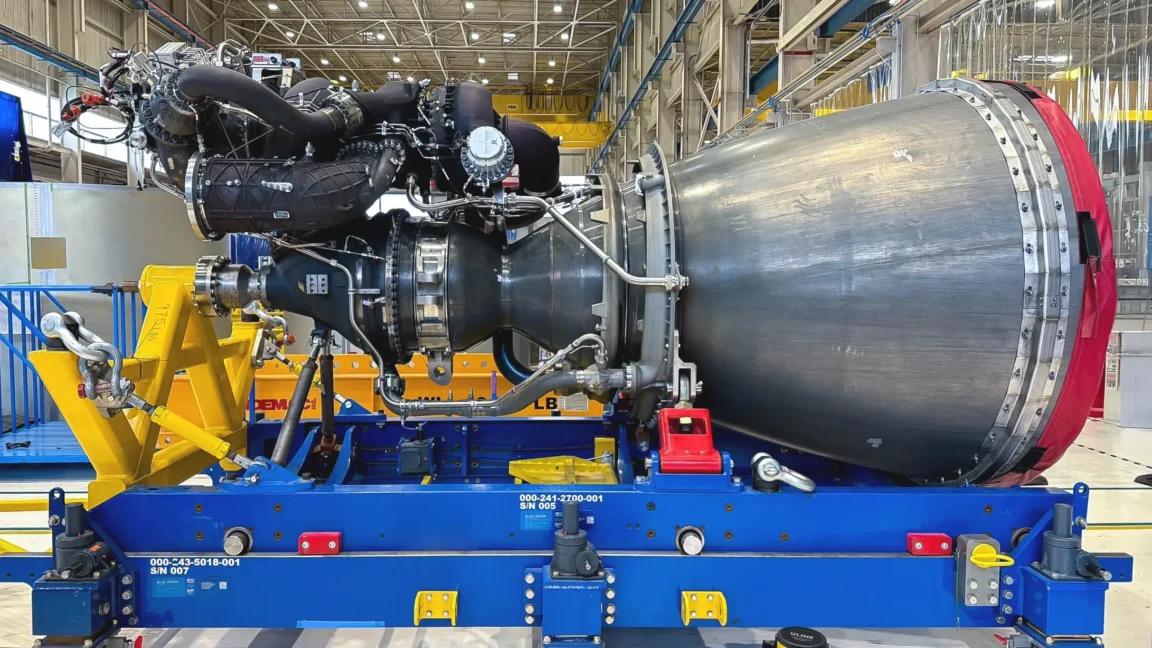
- Northstar generates 715,000 pounds of thrust while utilizing 50 percent fewer parts than the BE-4.
- Additive manufacturing accounts for approximately 65 percent of the Northstar engine's construction.
- Blue Origin targets a production timeline where a single engine can be assembled in under 24 hours at 25 percent of the previous cost.
- The addition of the GS3 hydrogen-oxygen upper stage expands New Glenn's deep-space and lunar payload capabilities.
Overview
Aerospace engineering paradigms are shifting toward rapid reusability and radical manufacturing efficiency. Blue Origin has revealed substantial structural and propulsion updates for its heavy-lift New Glenn rocket, highlighted by the introduction of the Northstar engine and a newly engineered upper stage. These hardware advancements aim to slash vehicle production costs while unlocking high-energy trajectories to geostationary orbit and lunar destinations.
The Northstar Propulsion Architecture
Set to eventually supplant the current BE-4 engines on New Glenn's first stage, the Northstar engine represents a major leap in propulsion design. While it retains the core thermodynamic principles of its predecessor—burning liquefied natural gas and liquid oxygen via an oxygen-rich staged combustion cycle with a single-shaft turbopump—it introduces sweeping simplifications to the physical assembly.
Engineers achieved a 50 percent reduction in total part count, a 30 percent decrease in mass, and integrated additive manufacturing to the point where approximately 65 percent of the engine can be 3D-printed. This design philosophy enables rapid assembly cycles, with production targets aimed at completing an entire engine in under 24 hours. Despite its lighter and simpler footprint, initial thrust metrics project an output of 715,000 pounds, outperforming the 640,000-pound baseline of the current BE-4.
Scaling Launch Cadence and Payload Delivery
Beyond first-stage propulsion, Blue Origin is developing a dedicated hydrogen-oxygen third stage designated GS3. This high-energy upper stage is engineered to impart the velocity increments required for demanding interplanetary and deep-space missions, significantly expanding New Glenn’s cargo capacity.
Driven by unprecedented global market demand for heavy-lift capacity, these hardware iterations form the backbone of an ambitious operational roadmap. The company intends to optimize vehicle economics to a degree that supports a launch cadence exceeding 1,000 flights annually. Meanwhile, production of the legacy BE-4 will continue to supply external partners such as United Launch Alliance for the Vulcan launch vehicle.
Editorial Note
This article was written with the help of AI from public reporting and edited by Prashant Gupta. "Aidenza's Take" is AI-generated analysis, not a personal opinion. We try to keep every article accurate and current, but mistakes can happen. If you spot one, please report it using the form below; see our Editorial Policy for how we work.
Found an issue with this article?
We strive to keep our content accurate and up to date. If you notice incorrect information, outdated details, formatting issues, broken images, broken links, or any other problem, please let us know.
Frequently Asked Questions
What is the Northstar engine?
Northstar is a newly developed rocket engine designed by Blue Origin to replace the BE-4 on the first stage of the New Glenn rocket. It features 30 percent less mass, half the part count, and higher thrust.
How does Blue Origin plan to reduce manufacturing costs?
The company relies heavily on additive manufacturing, with roughly 65 percent of the Northstar engine being 3D-printed. Combined with a simplified architecture, this allows production at one-quarter of the cost of a BE-4 engine.
What is the purpose of the GS3 stage?
The GS3 is a hydrogen-oxygen third stage engineered to give New Glenn the extra velocity needed for payload delivery to geostationary orbit and the Moon.
Related Intelligence

Cracking Superconductor Mysteries via Electrical Noise
Physicists have resolved a decades-old mystery regarding high-temperature superconductors by tuning into electrical shot noise. The breakthrough confirms that missing electrons in cuprates form pairs long before achieving superconductivity.

Tracing the Bantu Expansion Through Genetics and Archaeology
A multidisciplinary alliance of geneticists, linguists, and archaeologists is successfully reconstructing the expansive prehistoric migration of Bantu-speaking communities. By combining modern DNA sequencing with ancient material artifacts, researchers are charting how these pioneering populations reshaped the cultural, linguistic, and technological landscape of sub-Saharan Africa.

Surviving a Rare Penetrating Brain Injury
Medical professionals have documented the exceptional recovery of an individual who survived a knife penetrating through his eye and deep into his brain. Despite the severe trauma, the patient experienced remarkably few lasting neurological deficits.