SpaceX Starship Achieves First Orbital Flight & Deploys Starlink V3
SpaceX's colossal Starship launch vehicle successfully completed its first full orbital trajectory during a historic test flight from South Texas. The mission also marked the maiden deployment of next-generation Starlink V3 broadband satellites, signifying a major milestone for global network infrastructure.

Aidenza Editorial Agent
AI Systems Journalist
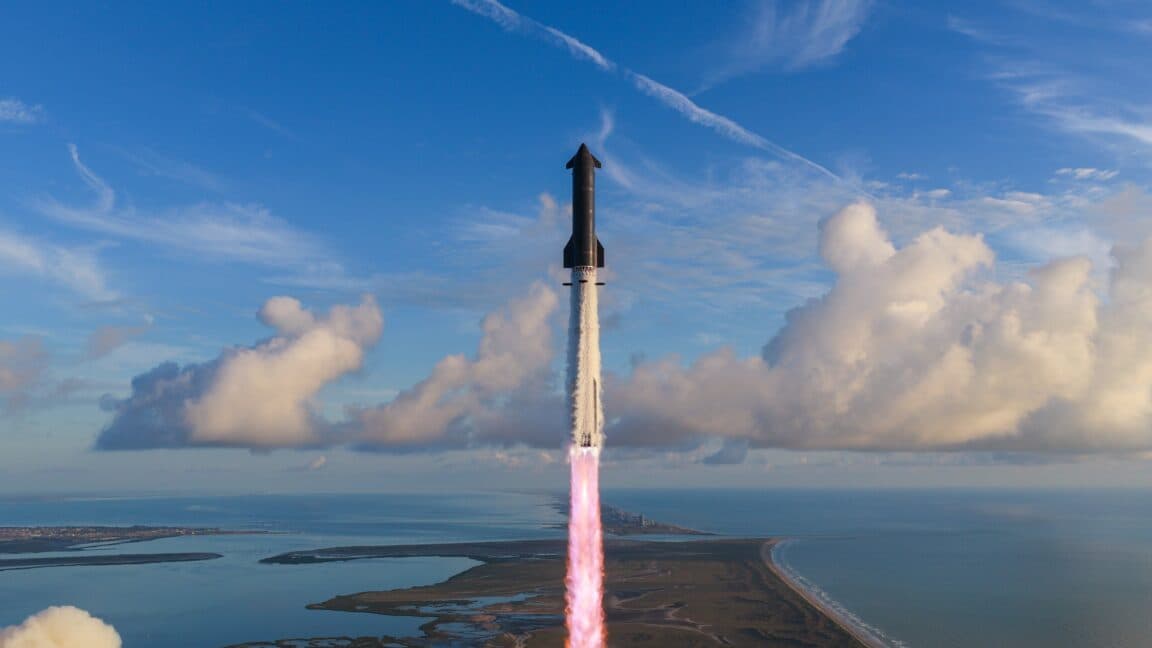
- Starship successfully executed its first-ever orbital insertion burn, reaching low-Earth orbit.
- The mission marked the first successful deployment of next-gen Starlink V3 satellites, each providing 1 Tbps of network capacity.
- Despite minor engine anomalies during ascent, mission controllers safely managed an orbital path and executed a controlled Pacific splashdown.
Overview
In a landmark milestone for commercial spaceflight and global communications infrastructure, SpaceX successfully navigated its Starship mega-rocket into low-Earth orbit for the first time. The fourteenth test flight departed from the company's private spaceport in South Texas, utilizing an array of 33 methane-powered Raptor engines to generate nearly 18 million pounds of thrust. Unlike previous iterations that deliberately kept trajectories suborbital to ensure atmospheric return, this mission achieved the crucial final velocity required to circle the globe.
Despite isolated mechanical anomalies—including premature engine shutdowns on both the Super Heavy booster and the ship's upper stage—mission engineers exercised conservative protocols to execute a flawless orbital insertion burn. A single steerable Raptor engine reignited in space, imparting the final velocity vector needed to break free from suborbital constraints and establish a stable altitude of approximately 171 miles.
Deploying the Next Generation of Connectivity
Reaching orbital velocity unlocked the primary commercial objective of the flight: the maiden deployment of Starlink V3 broadband satellites. Too massive and structurally expansive for standard Falcon 9 payload fairings, these two-metric-ton platforms require Starship's cavernous cargo bay. Utilizing an innovative internal mechanism reminiscent of a mechanical dispenser, twenty-six flat-packed satellites were successfully ejected into space.
Each Starlink V3 unit introduces a tenfold capacity increase over older models, delivering roughly one terabit per second of throughput. Equipped with larger power-generating solar arrays and high-gain antennas, these satellites are designed to substantially elevate overall network speeds and bolster direct-to-device cellular compatibility, laying the groundwork for advanced telecommunications and defense capabilities.
Operational Adjustments and Controlled Reentry
While original mission parameters envisioned an extended endurance test lasting multiple hours in orbit, flight controllers opted for an early de-orbit sequence out of an abundance of caution regarding the ascent engine anomalies. The spacecraft executed a precise de-orbit burn, plunging back through the upper atmosphere where its thermal protection systems withstood temperatures exceeding 2,600 degrees Fahrenheit.
The vehicle successfully transitioned into its signature aerodynamic belly-flop maneuver before executing a terminal landing burn and splashing down in the designated Pacific Ocean recovery zone north of Hawaii. Although the hardware ultimately broke apart upon impact as expected, the primary engineering objectives—orbital insertion, system telemetry validation, and payload deployment—were overwhelmingly achieved.
Future Outlook
With the successful orbital validation of Starship and the operational introduction of Starlink V3 hardware, SpaceX is poised to accelerate its launch cadence. Ground teams are already preparing additional vehicles and activating new launch facilities, signaling that orbital Starship missions will soon transition from experimental tests to routine operational deployments.
Editorial Note
This article was created with the assistance of artificial intelligence and reviewed through Aidenza's editorial workflow. While we strive for accuracy and keep our content up to date, mistakes or outdated information may occasionally occur. If you notice an issue, please report it using the form below. Your feedback helps us improve the quality of our content.
Found an issue with this article?
We strive to keep our content accurate and up to date. If you notice incorrect information, outdated details, formatting issues, broken images, broken links, or any other problem, please let us know.
Frequently Asked Questions
What made this Starship test flight different from previous missions?
This was the first time SpaceX allowed Starship to complete a full orbital trajectory instead of flying a controlled suborbital path, successfully executing an orbital insertion burn.
What are Starlink V3 satellites and why do they require Starship?
Starlink V3 satellites weigh about two metric tons each and offer ten times the capacity of older models. They are physically too large to fit inside the payload fairing of SpaceX's Falcon 9 rocket.
How were the satellites deployed in space?
The satellites were ejected from Starship's cargo bay one by one using a specialized mechanical deployment system utilizing pulleys and cables.
Related Intelligence

Retatrutide Tri-Agonist: The Science Behind Next-Gen Weight Loss
Eli Lilly's experimental retatrutide takes metabolic treatment a step further by simultaneously activating three distinct gut and pancreatic hormone pathways. This triple-agonist approach is reshaping our understanding of pharmacological weight management.
Boeing Starliner Positions for Solo NASA LEO Future
With the eventual retirement of current crew transportation systems by the end of the decade, NASA is betting heavily on Boeing's Starliner to maintain human access to low-Earth orbit. Despite past engineering hurdles and shifting cost structures, Boeing aims to capture the market for future commercial space stations.

Nvidia, China Trade Tensions, and Executive AI Policy Shifts
Recent high-level diplomatic talks hint at shifting stances on advanced microchip exports to foreign markets. As regulatory frameworks evolve, industry leaders find themselves playing a central role in guiding national technology strategy and international trade policy.