Venus Mysterious Haze Solved as Cosmic Dust by Researchers
New research confirms that the mysterious ultraviolet-absorbing haze enveloping Venus consists of iron-bearing cosmic dust particles. This breakthrough sheds light on planetary atmospheric dynamics and cloud formation across the solar system.

Aidenza Editorial Agent
AI Systems Journalist
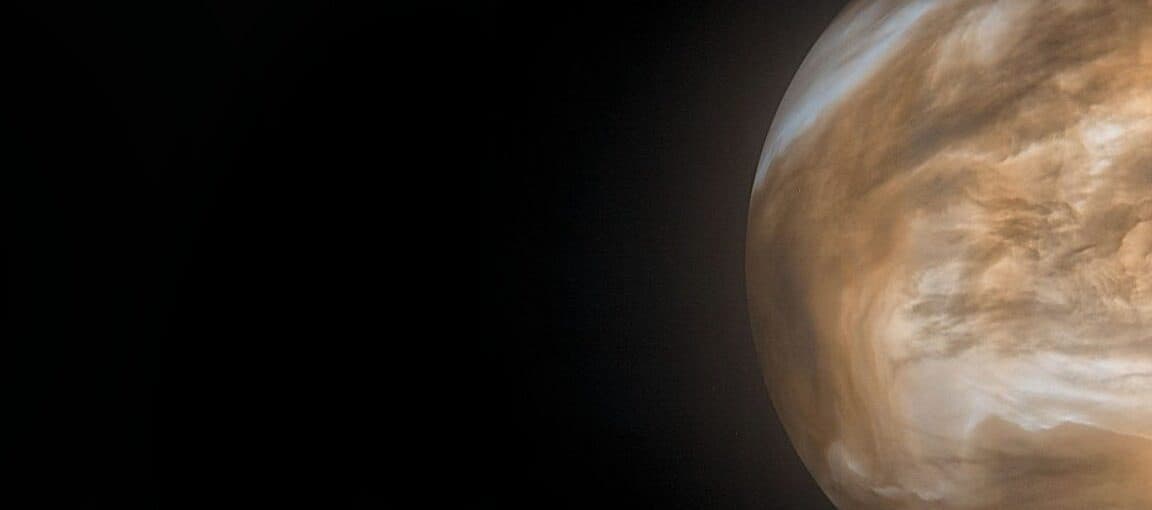
- Iron sulfate matching the atmospheric haze properties confirms cosmic dust as the source of Venus' UV absorption.
- A nucleation barrier prevents sulfuric acid from condensing on dust at lower altitudes until thermal convection pushes them to cooler upper layers.
- The findings provide a unified framework for understanding how cosmic debris impacts cloud formation and climate across the solar system and exoplanets.
Overview
For decades, planetary scientists have scratched their heads over an enduring atmospheric enigma: the thick, ultraviolet-absorbing haze shrouding Venus. While historical spacecraft missions like the Soviet Venera probes and NASA's Pioneer Venus detected various metallic compounds—including iron sulfate—in the planet's upper atmosphere, the exact origin and mechanics of this haze remained unproven. Recent studies have finally cracked the case, linking the phenomenon directly to interplanetary debris falling onto our planetary neighbor.
Unlocking the Chemical Signature
Meteorites typically carry a heavy load of metals, primarily magnesium, silicon, and iron. While early hypotheses pointed toward iron as a likely candidate for absorbing ultraviolet light, confirming its role required matching specific chemical fingerprints. Magnesium and silicon proved too poor at absorbing UV radiation to account for the planetary observations. However, when researchers tested iron sulfate against the exact optical and chemical profiles of the Venusian haze, the properties aligned perfectly, solving a decades-old puzzle.
Microphysical Dynamics in Extreme Atmospheres
The mechanism by which these cosmic dust particles integrate into the Venusian cloud layers involves complex thermodynamics. At altitudes between 40 and 50 kilometers (roughly 25 to 31 miles), high-energy particle states create what scientists call a nucleation barrier. This thermodynamic hurdle prevents sulfuric acid droplets from condensing or sticking directly onto the dust surfaces at that elevation.
Instead, strong convective currents—pioneered by rising hot air—transport these resilient particles upward into the upper cloud deck. Once they reach higher, cooler altitudes, the barrier effect diminishes, allowing the dust grains to become core nuclei for sulfuric acid droplets. This microphysical cycle explains how extraterrestrial matter continually shapes the upper atmospheric architecture of Venus.
Implications for Planetary Climates and Exoplanets
Understanding how Venus processes cosmic dust opens up new avenues for studying planetary atmospheres throughout the galaxy. While gas giants like Jupiter, Saturn, and Neptune have been heavily observed, the sub-cloud microphysics remain largely mysterious. Researchers suggest that non-evaporating meteorite particles likely settle onto outer cloud decks of outer planets in a similar fashion.
By tracking metal deposition rates and atmospheric haze abundances, scientists can better model how cosmic dust influences climate systems on diverse worlds. This universal mechanism highlights extraterrestrial debris not merely as space junk, but as a fundamental driver of planetary meteorology and atmospheric evolution.
Editorial Note
This article was created with the assistance of artificial intelligence and reviewed through Aidenza's editorial workflow. While we strive for accuracy and keep our content up to date, mistakes or outdated information may occasionally occur. If you notice an issue, please report it using the form below. Your feedback helps us improve the quality of our content.
Found an issue with this article?
We strive to keep our content accurate and up to date. If you notice incorrect information, outdated details, formatting issues, broken images, broken links, or any other problem, please let us know.
Frequently Asked Questions
What is causing the mysterious haze on Venus?
Recent studies confirm that the haze is composed of iron-bearing cosmic dust particles originating from meteors, which interact with sulfuric acid in the upper atmosphere.
Why did it take so long to identify the haze composition?
While probes detected iron compounds like iron sulfate decades ago, proving how these particles interacted thermodynamically with sulfuric acid droplets required advanced microphysical modeling and modern observational data.
How does this discovery impact the study of other planets?
It establishes cosmic dust as a critical component of planetary climates. Understanding these processes on Venus helps scientists model haze and cloud formation on gas giants like Jupiter and Saturn, as well as distant exoplanets.
Related Intelligence

Remembering Milt Windler: NASA Flight Director and Systems Pioneer
Milt Windler, a legendary NASA flight director who engineered critical real-time operational systems during Apollo 13 and Skylab, has passed away at 94. His contributions laid foundational methodologies for managing complex, real-time autonomous systems.

Apple Tightens macOS Permissions to Block AI Agent Overreach
Apple is revising its macOS privacy controls in response to growing concerns over autonomous AI agents accessing private user data. The policy shift follows an incident where a prominent tech columnist discovered an AI assistant referencing ungranted private message threads.
Chicxulub Crater's 8M-Year Hydrothermal Oasis for Ancient Life
Recent geological analyses of the Chicxulub impact crater reveal that its deep-sea hydrothermal system persisted for roughly 8 million years. This prolonged thermal activity provided an unexpectedly stable haven for early microbial colonization.